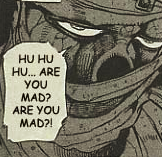
When discussing anonymous identification, in this case pertaining to online communities and forums, there are a few different issues to take into account. A few I discussed previously, in my short look at usernames and names, what they mean to us, and if they are important to a community.
On the other hand, when people are allowed to be anonymous, they can disconnect themselves from a name, as well as from their own appearance and history. This shield from accountability can lead to behavior that builds a community, or destroys it. Unrelated to the strength of the community, the behavior of the community may lean toward socially accepted good or bad based on the allowance of anonymous identification.
Note that this discussion will not relate to whether humans are naturally good or bad (the answer is neither by the way), since we are discussing matured humans who have accepted society. The basic nature of humans does not relate to how they act once integrated into the world.
Law, or more specifically criminology, has beliefs on the effectiveness of laws based on how likely a law is to be enforced. While people should not jaywalk, people often do so anyway because they don't know anyone that has been punished for jaywalking. The proliferation of music downloads, and torrenting, are also considered related to the likely-hood of being punished. While punishment related to music arrest have become more common in the news, it is usually punishment for those who run the websites or programs that download the music, not the downloaders themselves.
This idea reflects on society in general. While every culture reflects its ideas of unacceptable behavior on every child, a person may decide that they will take part in that unacceptable behavior if there is no fear of being punished. This is how people start smoking, cursing, watching porn, using racially charged words, etc. A child who knows their parents won't punish them if they skip school, has a high likely-hood of skipping more often.
We also know that as humans, we like to move with the crowd. From music, to art, to TV shows, to food, we like to do something if other people are doing it as well. The ancient phrase “If ____ jumped off a bridge, would you too?” is based on this very thing. When faced with the choice of acting like those we are often around, or following some greater rule of society, nature says to follow the crowd. If everyone looks one way, you look there too. If everyone starts running, you don't ask questions, you just get out of there!
So we know now that names are important for identification, accountability, and punishment. We also know that without the fear of punishment, humans may partake of behavior that they know is socially unacceptable. Finally, we know that humans like to act as a crowd, following what others are doing if they find enough people are doing it.
In relation to anonymous identification, communities that allow it, of course the primary case being Christopher Poole's 4chan.org, are a risky environment.
There are situations where people do good things when anonymous, blood donors, toy drives and other donations show that people can do great things when given the chance to do something without getting credit. Of course, these situations are also framed so that the one input that people can give, is good things. The movement of the crowd in this case is toward helping others, and since this framework is established there is no risk that unacceptable behavior will come out it.
When not given a structure, humans acting anonymously are a bit more random. Christopher Poole recently gave a presentation at the TED2010 conference, discussing some of the acts 4chan has accomplished. Saving a cat nicknamed Dusty was one, the resurgence of singer Rick Astley was another. The memetic spread of 4chan has greatly influenced the internet, this is undeniable. Lots of known memes, repeatable phrases and/or images, have either started or grown to full power on 4chan's pages. So has a lot of images of graphic violence, racist imagery and phrases, and mass piracy.
In the case of a site like that, where many posters discuss things with one another while many are completely anonymous, it does not take much for people to become negative, or purposely antagonize one another. The only consequence are breaking the hard rules of the community, anything short of that is accepted and therefore happens often. Trolling one another, purposely antagonizing someone in order to see their reaction or ruin their conversation, is not only common but a part of the culture.
Why this happens may relate to the earlier issues discussed. People are capable of acting good when anonymous, and if this happens then it is possible that others will see this and decide that they should also act good. When acting good though, there is no risk involved. On the other hand, an online community is the perfect place to act in ways that society usually does not allow or accept, because there is no risk for punishment. So when one person discovers this, and decides that they want to antagonize someone, or spill discriminating words for no reason, or show graphic imagery for no reason other than to shock someone; others see this, realize they can do likewise, and partake in the actions of the crowd.
An anonymous community has the capability to be very useful for the same reasons it is risky. It is also a place where people need not risk being judged based on past instigations or comments, each of their ideas can be identified and judged based on the comments merits. In a place where an arbiter made sure comments and rebuttals were relevant and informed, this would be a boon for frank discussion where people were not afraid to say the things everyone did not want to hear. Without these things, there is no reason to take a comment seriously, when it may be more fun for one of hundreds of people to troll the person's stance instead, giving falsified or unsubstantiated replies instead.
When looking at anonymous as a framework for an online community, there are a lot of issues, but a lot of possibility for gain. Though people may have the capability to do good things, or get a lot done, this often doesn't happen when it may seem more enjoyable or refreshing to antagonize one another instead. This is not a reason to abandon the internet as a place of community though.
Image from Penny-arcade.com